- Main page
- Information Center
- Government News
Government News
Visit korean.net to see a variety of policies and relevant news of the Korean government.
[Local 100] ① Haebangchon: old alleys mixed with modern stores
- Source
- korea.net
- Date
- 2026.05.22
The "real Korea" lies hidden in alleys. Based on the Local 100, a list of cultural attractions selected by the Ministry of Culture, Sports and Tourism, Korea.net explores notable locations nationwide that combine history, art and people.
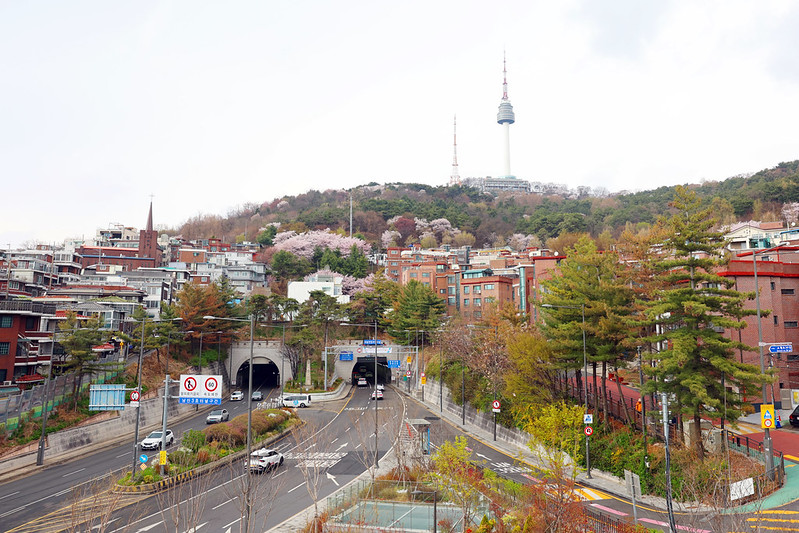
Haebangchon has grown popular among visitors as the setting for the hit K-dramas "When the Camellia Blooms" (2019) and "Itaewon Class" (2020). (Lee Jeongwoo)
By Lee Jihae
Haebangchon: first town at foot of Namsan Mountain
Haebangchon, just one stop away from the bustling Itaewon Station in Seoul's Yongsan-gu District, is among the Local 100, a list of top cultural attractions selected by the Ministry of Culture, Sports and Tourism. It has grabbed global attention as the backdrops for popular K-dramas such as "When the Camellia Blooms" (2019) and "Itaewon Class" (2020).
The area attracts young people and tourists alike through a combination of old alleys and distinctive shops.
Korea.net visited Haebangchon with a guide from the Seoul Tourism Organization who provided background information on the neighborhood.
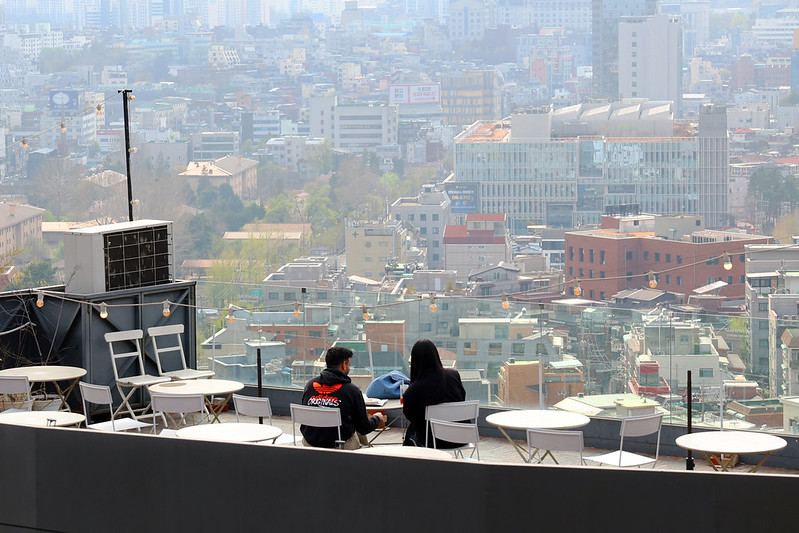
Haebangchon is nestled along the steep slopes of Namsan Mountain, with this rooftop cafe offering panoramic views of downtown Seoul. (Lee Jeongwoo)
As a neighborhood formed on the slopes at the foot of Namsan Mountain, the area offers close views of N Seoul Tower from almost anywhere in Haebangchon. Due to its high elevation, the area boasts panoramic views of downtown Seoul from as low as the second or third floor of a building.
Founded on joy of liberation, pain of displacement
The name "Haebangchon" encapsulates the ups and downs of modern Korean history, with haebang literally meaning "liberation" and referring to independence from Japanese colonial rule in 1945. The neighborhood gained that name after Koreans who returned from abroad after 1945 settled there, followed by refugees from the northern half of the Korean Peninsula after the Korean War (1950-53).
The place was once considered a symbol of poverty due to the difficulty of development because of steep slopes and a dense shantytown. Ironically, the rugged terrains and old buildings eventually turned it into a unique place filled with stores run by expats and the studios of young artists in the alleys, creating a distinctive atmosphere.
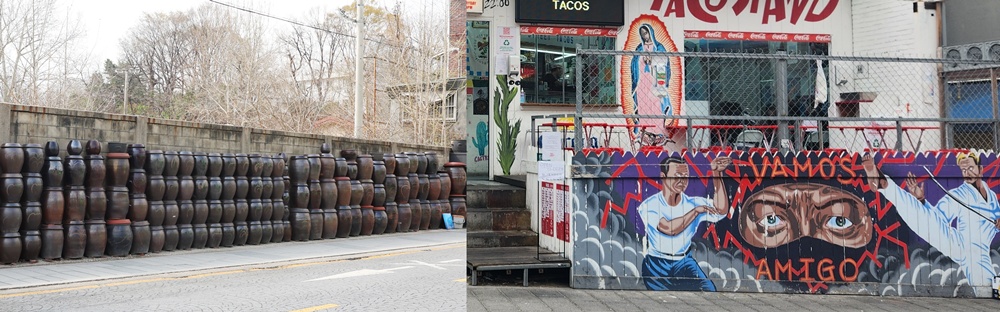
On the left are earthenware pots lining the alley leading from the entrance to Haebangchon near Exit 2 of Noksapyeong Station on Seoul Subway Line 6, and on the right is a store reflecting its owner's unique personality. (Lee Jeongwoo)
Alleys with unique stores instead of franchises
Upon leaving Exit 2 of Noksapyeong Station on Seoul Subway Line 6 and walking along the street, earthenware pots aligned at the entrance to Haebangchon come into view. Neatly arranged along the roadside, these pots offer an unexpected glimpse of antique charm amid the modern city center.
The unique atmosphere of Haebangchon is further intensified by the influence of the nearby Yongsan U.S. Army Garrison. Shops run by foreign residents line every alley, making the place feel like a street overseas, and instead of large franchises, small stores reflecting the owners' individual personalities dominate.
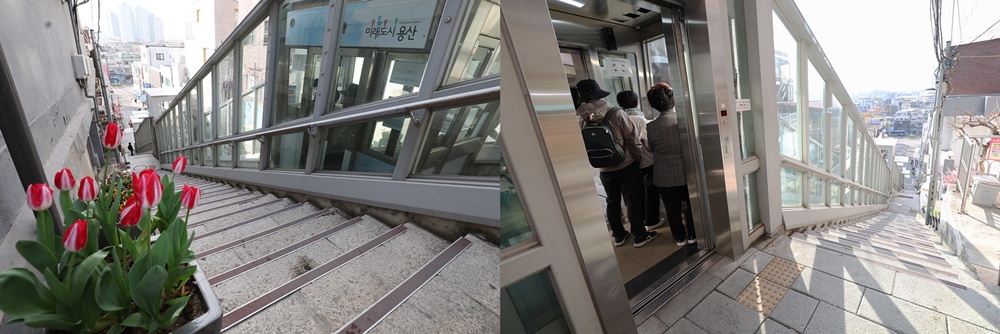
The 108 Steps (left) are a well-known filming location for popular K-dramas. On the right is a sloped elevator along the stairs. (Lee Jeongwoo)
108 Steps: leading to shrine during Japanese occupation
Famous as a setting for the K-drama "Something Happened in Bali" (2004), Haebangchon is a beloved spot known for its narrow and tranquil atmosphere. The staircase's 108 steps represent the 108 earthly desires in Buddhism.
The stairs originally led to the entrance to Gyeongseong Hoguk Shrine, which was built by the Japanese colonial government in 1943 to honor fallen soldiers. The facility housed the tablets of such Japanese soldiers as well as cons.cripted Koreans forced to fight for Japan during the second Sino-Japanese War (1937–45) and the Pacific theater of World War II (1941–45).
The shrine is long gone and in its place is a dormitory for international students at Sookmyung Women's University. An inclined elevator slowly ascends and descends alongside the stairs.
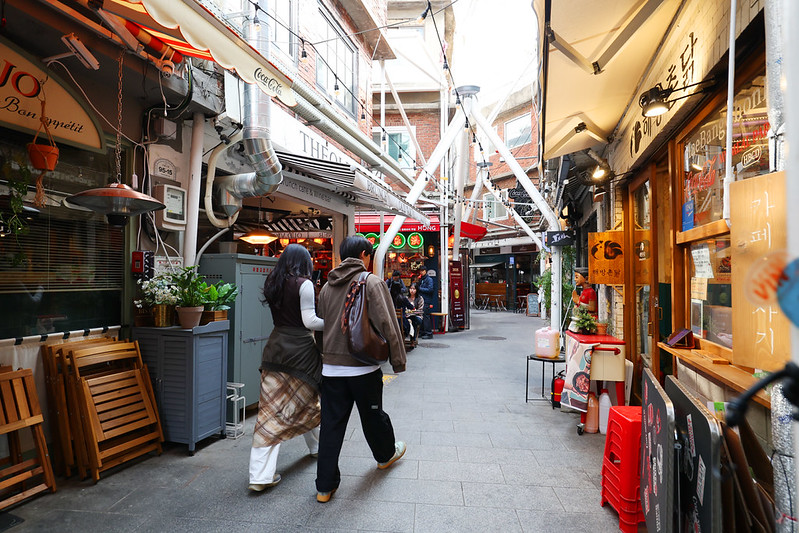
Shinheung Market in Haebangchon (Lee Jeongwoo)
Shinheung Market: old-world charm meets modern styles
Shinheung Market in Haebangchon, sporting a vintage charm with old brick buildings blending with modern sophisticated stores, is popular among youth as a "newtro" hot spot. The term "newtro" is a portmanteau of the words "new" and "retro."
Modern businesses stand in contrast to old, narrow alleyways for a mise-en-scene effect, making the area a favored filming location for K-dramas and movies.
In the 1970s and 80s, Shinheung was the heart of the boom in Haebangchon's household cottage industries. Knitting machines during this period ran around the clock, and sweaters, gloves, socks and other items were carefully knitted in every home for sale on the market.
As a distribution hub, Shinheung was where products were packaged for shipping across the country.
Stagnation began in the 1990s due to the emergence of mass producers of textiles and clothing and relocation of related factories to the outskirts. It was not until the 2010s that the place grew vibrant again.
Unique cafes and workshops were set up at vacant storefronts, heralding the market's revival. In 2021, the installation of an arcade roof covering the entire market completed its distinctive landscape, where past and present coexist.
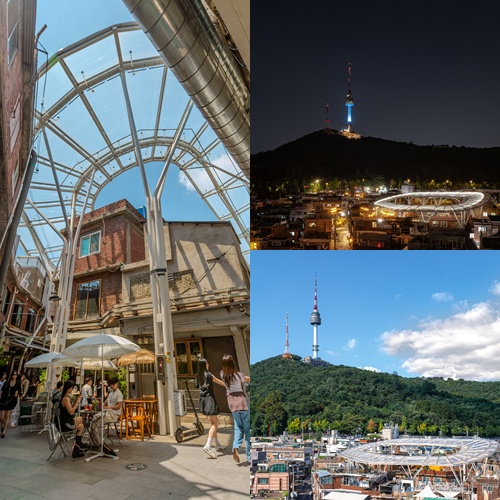
On the left is the Cloud Roof of Shinheung Market in Haebangchon. The top and bottom right images show panoramic views of the roof taken from the outside at night and during the day. (Urban Idea Agency, Shin Jaeik and Dongha Kim)
jihlee08@korea.kr