- Main page
- Information Center
- Government News
Government News
Visit korean.net to see a variety of policies and relevant news of the Korean government.
New high-tech clothing automates dressing for elderly, disabled
- Source
- korea.net
- Date
- 2026.07.23
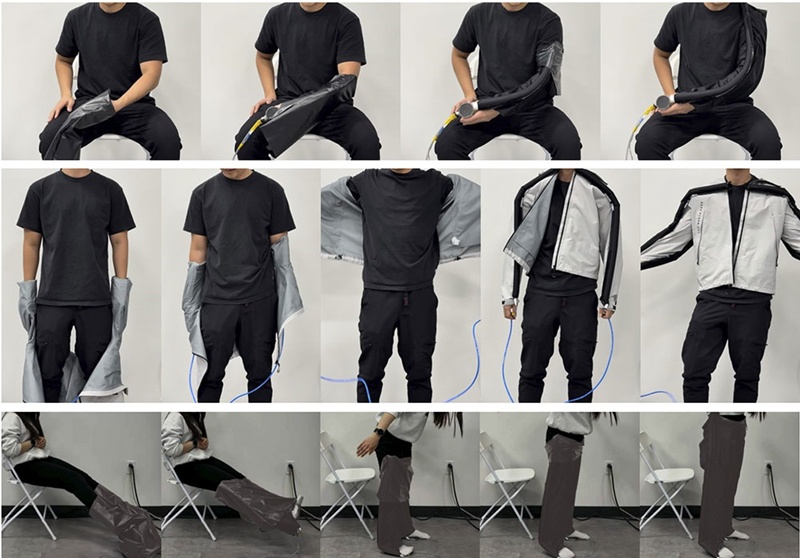
This is the process in which garments and their components like sleeves, a jacket and pants unfold themselves and help wearers get dressed through the power of air pressure. (KAIST)
By Koh Hyunjeong
Video = KAIST
Getting dressed is a daily necessity for almost everyone but can also be a struggle for senior citizens, people with disabilities and those undergoing rehabilitation.
For them, even simple actions such as putting arms through sleeves or pulling up pants can prove difficult.
A research team led by professor Ryu Jee-Hwan at the Department of Civil and Environmental Engineering of the Korea Advanced Institute of Science and Technology (KAIST) has developed a new concept in high-tech clothing in which garments can unfold themselves to conform to a wearer's body and automate dressing.
Unlike an external robotic device that helps one put on clothes, this new technology makes the apparel move itself to dress the wearer. Similar to an ivy climbing a wall, the clothing naturally unfolds along the body.
Over the years, researchers have studied robotics that help people put on and off their clothing. But developing the know-how to safely assist in the process was difficult since clothing is soft and malleable and a user's posture can differ each time.
The team took a different approach. Instead of using an external robotic device, it incorporated actuators in the clothes to allow automatic movement. As a result, the technology offers natural help in getting dressed while reducing the physical strain on the wearer.
The clothes seem no different from ordinary garments on the surface. But press a button and air is injected into the clothes to unfold the clothing as it turns inside out, then it wraps itself around the arms, legs and contours of the wearer's body.
The key is a pneumatic deployment structure in which the folded item flips and unfolds when air is injected. The researchers incorporated soft growing robot technology, which unfolds and extends as if growing through air pressure, into the internal structure of the clothes.
Conventional wearable assistance robots are often bulky and difficult to control, which can cause inconvenience by restricting user movement or requiring adaptation to the robotic system.
In contrast, this new technology allows the clothing itself to move, allowing a far more natural and safer dressing.
The team experimented with an array of garment types like shirts, jackets and pants. The results showed how the clothing stably unfolded along the contours of the body without excessive pressure.
This technology can help people undergoing rehabilitation get dressed as well as senior citizens and people with disabilities.
Its application scope is also expected to expand to medicine and assistive technology, as well as work environments in which wearing protective gear can be troublesome like suits for infection control, firefighting and industrial safety.
The study was presented in May at this year's IEEE (Institute of Electrical and Electronics Engineers) International Conference on Robotics and Automation, the world’s largest event of its kind, in Vienna, Austria. It also received the Best Paper Award from IEEE Robotics and Automation Letters.
"This research is significant in extending the core principles of soft growing robots to assistive technology for putting on clothing in daily life," Ryu said. "We will keep studying human-friendly soft robots."
hjkoh@korea.kr