- Main page
- Information Center
- Government News
Government News
Visit korean.net to see a variety of policies and relevant news of the Korean government.
[Global K-life] ⑤ Hallyu steering fans toward Korean literature
- Source
- korea.net
- Date
- 2026.08.14
| Korean culture has transcended being just a passing fad and evolved into part of daily life worldwide. In this five-part series, Korea.net examines the factors behind the global popularity of Korean content in music, cinema, food, beauty and literature and explores how Hallyu (Korean Wave) can have a sustainable future and its strategies for steady growth as well as analyzing the phenomenon. |
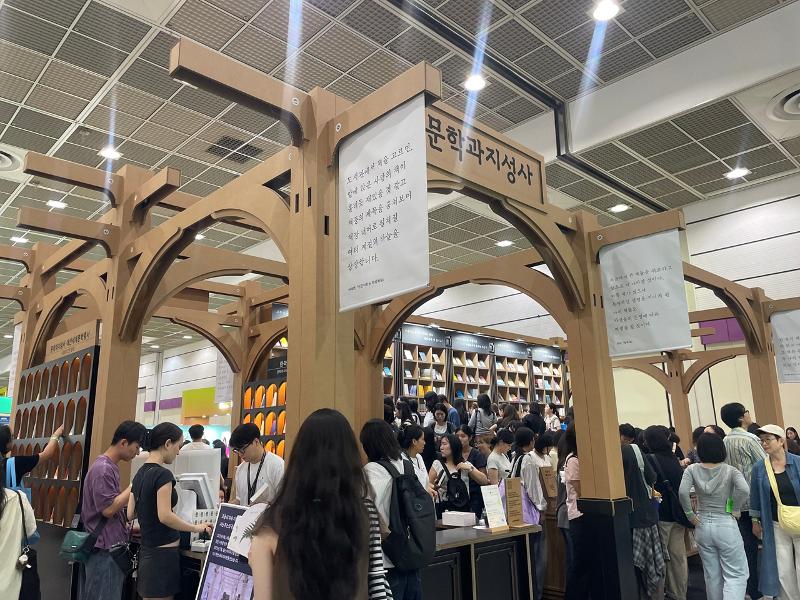
The publisher Moonji Publishing Co. on June 24 runs a booth at the Seoul International Book Fair at the convention center Coex in Seoul's Gangnam-gu District. (Kim Seon Ah)
By Kim Seon Ah
The country's literature is transcending borders to hit the bookshelves of readers all over the world.
The Literature Translation Institute of Korea on July 28 released the results of a survey of the overseas sales of books whose translation and publication it supported from 2021-25. The study found that cumulative sales of 1,026 titles across 40 language markets reached a record-high 3.58 million copies, about 900,000 more than from 2019-24.
Sales last year alone hit 1.2 million copies, the second consecutive year of reaching that figure. This suggested that Korean literature secured a broader readership spanning major language markets and needs not to rely on the effects of the Nobel Prize in Literature or a few bestsellers.
K-pop and K-dramas are no longer the only forms of content that bring Korea to mind worldwide. Bookstores across the globe are steadily stocking Korean novels, essays and picture books and Korean writers and publishers are attracting growing interest at international book fairs.
A visitor from Indonesia and another from Poland who attended the Seoul International Book Fair last month at the convention center Coex in Seoul said they gained a deeper understanding of Korea through reading Korean works.
Resita, a publishing professional based in Jakarta, Indonesia, cited "authenticity" and "empathy" as the biggest appeals of Korean literature.
Invited to the fair by the Korean government and the Publication Industry Promotion Agency of Korea, she said, "Many Korean books have already been translated and published in Indonesia and gained positive responses," adding, "Various genres ranging from drama and suspense to self-help are resonating with Indonesian readers."
Resita said 2024 Nobel laureate Han Kang was the first Korean author whose work she read. On Baek Se-hee's "I Want to Die But I Want to Eat Tteokbokki," she called it a work that "candidly deals with mental health and provides comfort and inspiration to many readers."
She picked as her favorite Korean book Hwang Bo-reum's "Welcome to the Hyunam-dong Bookshop," dubbing it "a story that anyone who loves reading can relate to."
Resita said she believes Korean literature has won over readers worldwide because "the authors' thoughts and emotions are conveyed so honestly that a work and its author feel almost inseparable," adding, "That authenticity touches readers' hearts."
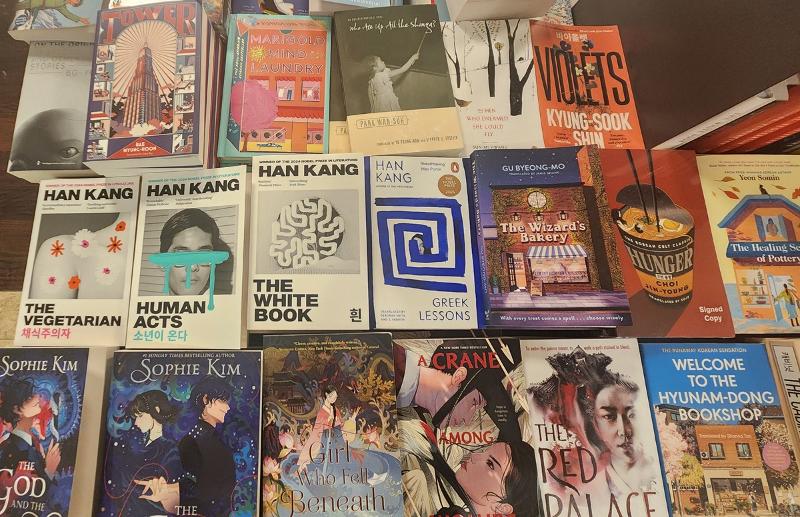
English-language translations of Korean literary works are displayed Gwanghwamun Kyobo Bookstore in Seoul's Jongno-gu District. (Lee Jihae)
Ewa Kaletyn, a graphic designer and art director from Poland, said what first drew her to Korean books was their beauty.
Now learning Korean, she said she cannot read books in the original Korean text but that she is exploring Korean publishing culture, especially picture books, because of the aesthetic sensibility, illustrations, color palettes and layouts."
Kaletyn said she has read novels by Shin Kyung-sook and Kim Ho-yeon and enjoys picture books produced by Korean publishers Borim Book, Bom Bom and Gilbut Kid.
Her interest in K-dramas led her to Korean books. She said she was most impressed at the book fair by the independent publishing section, booths designed like bakeries and the warm hospitality.
Both visitors were drawn to Korean literature for different reasons. Resita was captivated by the empathy and authenticity in such works and Kaletyn by the beauty of their design and publishing culture. Yet both were ultimately attracted to the genre through their interest in Korean culture.
"There are many fans who seek out and read Korean books recommended by K-pop artists who like reading, such as RM from BTS," Resita said.
Kaletyn added, "K-dramas are what first sparked my interest in Korean culture."
K-pop and K-dramas are windows through which the world has discovered Korea, and Korean literature is emerging as the newest window by conveying the lives and emotions of Koreans through the printed word. One book can transcend language, resonate with readers and forge new connections between Korea and the rest of the world.
sofiakim218@korea.kr