- Main page
- Information Center
- Government News
Government News
Visit korean.net to see a variety of policies and relevant news of the Korean government.
New strategy to develop 7 key sectors as future growth engines
- Source
- korea.net
- Date
- 2026.08.18
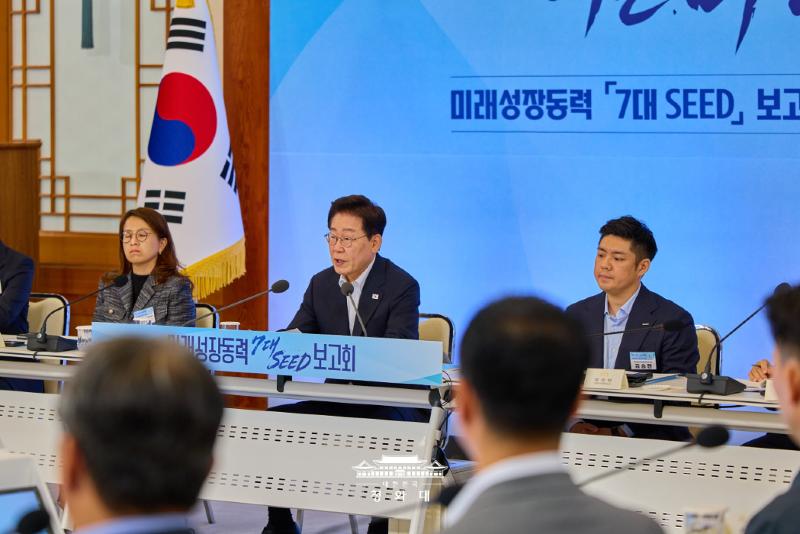
President Lee Jae Myung (second from left) on Aug. 12 pledged his administration's firm commitment to develop cutting-edge technologies at a meeting on an initiative for seven SEED (strategic emerging engine for disruptive innovation) projects for future growth at Cheong Wa Dae in Seoul.
By Yoon Sojung
Photos = Cheong Wa Dae
A new strategy seeks to advance next-generation cutting-edge technologies over the next decade or two to ensure the country's survival.
The Ministry of Science and ICT on Aug. 12 announced this at a meeting on promoting seven SEED (strategic emerging engines for disruptive innovation) projects as future growth engines at Cheong Wa Dae in Seoul.
The seven form a national initiative for developing cutting-edge technologies, which are core assets for both the economy and national security, as future growth engines in three major areas: future clean energy like small modular reactors (SMRs), nuclear fusion and renewable energy to tackle power demand and achieve carbon neutrality; next-generation frontier sectors such as quantum technology, aerospace and advanced biotechnology; and advanced supply chains.
First, a public-private partnership from next year will jointly conduct detailed design work for SMRs, a carbon-free energy source. The development targets are commercial application of light-water SMRs by 2035 and the launch of construction of non-light-water models in the 2030s.
In nuclear fusion, often dubbed "artificial sun" technology, development timelines for reactors will be shortened through the use of "artificial intelligence (AI)-based" virtual fusion plants. The goal is to demonstrate by 2035 a homegrown innovative fusion reactor of 100 megawatts and start commercial power generation by 2040.
In wind power, the plan is to develop the sector into a next-generation export industry by securing core technologies for ultra-large 2-megawatt-class turbines and core floating know-how. For hydrogen, a timely supply of clean hydrogen will come from the localization of electrolysis systems and demonstration of large-scale electrolysis facilities between 50 and 100 megawatts.
In next-generation frontier technology, quantum computing, space and biotechnology were named core areas. The plan is to secure by 2029 a 100-qubit processing unit that can correct errors.
Through a national competition to produce quantum computers, domestic companies will lead the development of a full stack quantum computer comprising everything from quantum chips to software.
The K-quantum Foundry project, which seeks to boost domestic semiconductor know-how, will be pursued through special purpose companies (SPCs) led by major semiconductor makers to build a mass-production system for quantum chips and lead the world in manufacturing capability within a decade. Also in the works are supra-regional quantum clusters to find quantum application cases linked to key regional industries and set up a quantum security system.
In space science, Korea will secure independent technical capacity by launching its first privately led 700-kg-class lunar lander by 2030 and an 1,800-kg-class model in 2032.
Another plan is to advance the low-Earth orbit (LEO) space industry by securing core technologies for space data centers and active-control satellite in stages, as well as completing a homegrown LEO satellite communications network by 2035.
In advanced biotechnology, the construction of AI-bio infrastructure will include cancer-specific AI models, autonomous labs driven by AI and robots, and biofoundaries by 2030. The goal is to secure new blockbuster-level drugs and mass produce bioplastics.
Moreover, the development of core brain-computer interface (BCI) technologies such as AI for brain-to-text translation will seek to commercialize a BCI system for text input via thought alone by 2035, as well as the launch of an SPC to commercialize gene and cell therapies.
Also at the meeting, the Ministry of Trade, Industry and Energy announced a strategy for building an advanced ecosystem for supply chains as one of the seven SEED projects.
For items essential to national survival, the ministry will bolster processing capabilities, raise the recycling rate of 10 key minerals to 20% by 2030 and build a domestic production base.
For items that cannot be produced domestically, the number of stockpiled items will be raised from 24 to 29 and the expansion of stockpile levels will be expanded from 180 days to 365. Crisis response capabilities will also be improved by diversifying supply chains through summit diplomacy.
A forthcoming public-private task force on future pioneering led by the science and ICT minister will review the detailed roadmap and progress in implementation through a ministerial meeting on science and technology.
President Lee Jae Myung called capacity in science and technology is the top indicator of national power given the surge in global technological competition, pledging strong government support to allow innovative companies and scientists to freely pioneer markets.
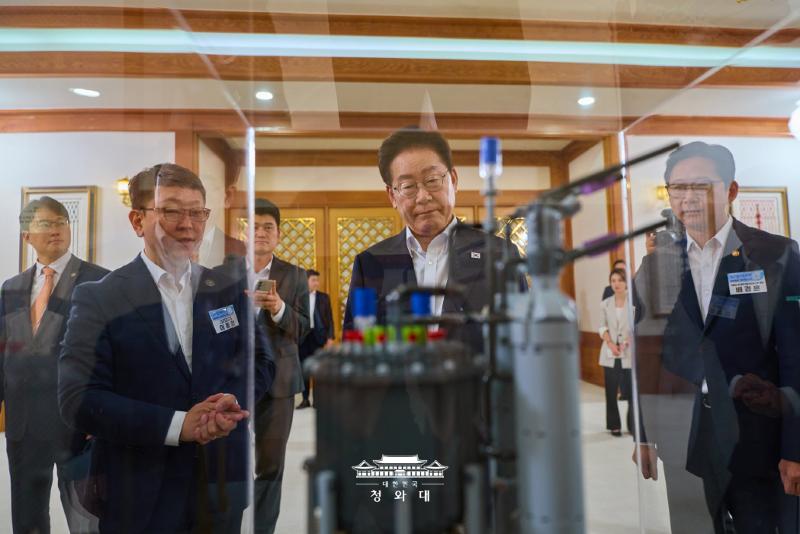
President Lee Jae Myung (second from left in front row) on Aug. 12 looks at a model of a container ship equipped with an SMR before the meeting on the seven SEEDs for future growth at Cheong Wa Dae in Seoul.
arete@korea.kr