- Main page
- Information Center
- Government News
Government News
Visit korean.net to see a variety of policies and relevant news of the Korean government.
Finance minister: Korea's strengths to shine in physical AI era
- Source
- korea.net
- Date
- 2026.08.21
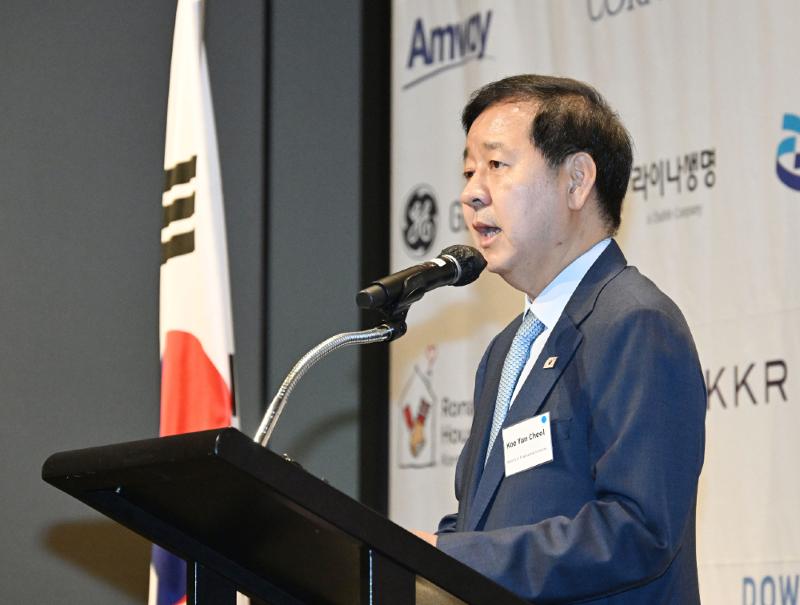
Deputy Prime Minister and Minister of Finance and Economy Koo Yun Cheol on Aug. 19 introduces the government's economic vision and expresses Seoul's commitment to raising economic cooperation with the U.S. at a roundtable hosted by the American Chamber of Commerce in Korea at the hotel Grand Hyatt Seoul Hotel in the capital's Yongsan-gu District. (Ministry of Finance and Economy)
By Yoon Sojung
Deputy Prime Minister and Minister of Finance and Economy Koo Yun Cheol says the country's strengths will come to the fore in the era of physical artificial intelligence (AI), adding, "If active bilateral cooperation with the U.S. persists, this will turn into a 'win-win relationship' that generates the world's highest added value in the AI era."
He said this on Aug. 19 at an invitation-only roundtable hosted by the American Chamber of Commerce (AMCHAM) in Korea at the hotel Grand Hyatt Seoul in the capital's Yongsan-gu District.
"President Lee Jae Myung securing a cooperation agreement worth USD 950 billion between Korean companies and U.S. Big Tech at the recent AI Summit in San Francisco clearly proves Korea's big potential as a key hub in the global AI supply chain," he added.
"Building on Korea's strengths like comprehensive manufacturing capabilities, know-how and abundant field data across the AI ecosystem such as infrastructure, chips and models, our government will focus on developing AI's core pillars through three major megaprojects and provide full-scale support."
Minister Koo also presented Seoul's economic vision and strategies for emerging as a hub for AI and finance. He explained the "3-4-5 Vision," which seeks a potential growth rate in the 3% range, entry into the ranks of the world's top four exporting countries and per capita income of USD 50,000.
As part of the three megaprojects -- semiconductors, AI data centers and physical AI -- the core of the 3-4-5 vision, he said, "We will advance physical AI as a national strategic industry to further elevate the competitiveness of the manufacturing sector."
Stressing the role of the capital market in achieving the 3-4-5 vision, Minister Koo outlined government efforts to align foreign exchange regulations with global standards, including amendments to the Commercial Act, inclusion of domestic government bonds in the World Government Bond Index, launch of a roadmap to make the KRW a global currency and transition into a foreign currency market that runs 24 hours a day.
On a report on promoting Korea as a global financial hub submitted in April by the chamber, he said, "In response to AMCHAM's recommendations, we decided to raise the thresholds for reporting foreign currency borrowings by foreign bank branches and the consolidated limit on fund management from USD 50 million to a minimum of USD 100 million."
Later in talks with AMCHAM Chairman James Kim after the keynote speech, the minister explained his views on key tasks of achieving the 3-4-5 vision, directions for mid- to long-term growth, strategies to make Korea a global AI hub and improvement of access to financial markets.
Minister Koo also discussed raising cooperation between Seoul and the recently launched AMCHAM AI Leadership Council.
On the implementation of Korea's proposed USD 350 billion strategic investment in the U.S., the minister said the institutional foundation for this was established in June with the official launch of the Korea-U.S. Strategic Investment Corporation. He highlighted the importance of the private sector in both countries in jointly identifying projects deemed commercially viable and mutually beneficial, urging AMCHAM to play a bridging role in this process.
"Korea's global economic standing continues to rise. Its capital markets have reached new heights, Korean companies are playing an increasingly important role in global supply chains, and the country is emerging as a key player in the global AI transformation," Kim said.
"The growing global prominence of its firms reflects Korea's remarkable economic transformation and underscores the opportunity for Korea to establish itself as a leading hub for investment, innovation, finance, and business."
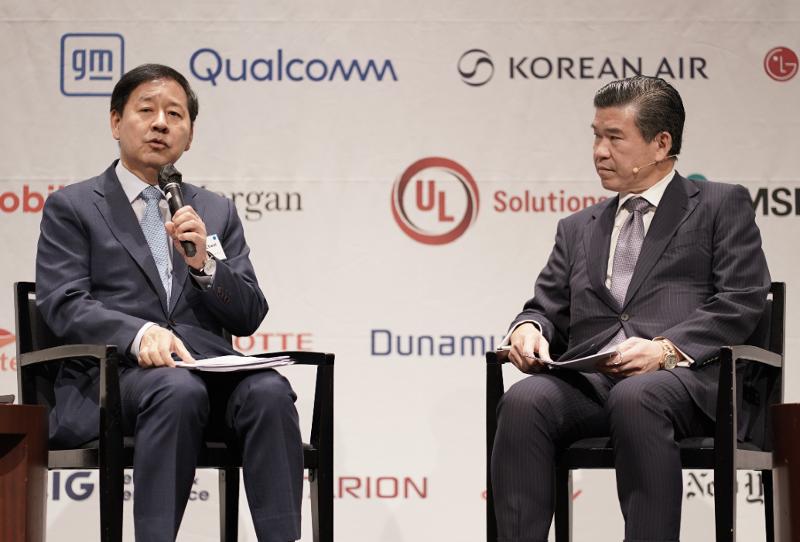
Deputy Prime Minister and Minister of Finance and Economy Koo Yun Cheol (left) on Aug. 19 explains the government's bid to boost bilateral economic cooperation with the U.S. to American Chamber of Commerce in Korea (AMCHAM) Chairman and CEO James Kim at a luncheon hosted by the chamber at the hotel Grand Hyatt Seoul in the capital's Yongsan-gu District. (AMCHAM)
arete@korea.kr